The mind plays games. As I have aged, I look back on my earlier work (years and decades ago) and question whether it was me who made the photographs and wrote the essays. They seem to have been made by a more talented photographer and writer. These thoughts got stirred up while I was looking through a book that I made in 1998 called “Subconscious Perceptions”.
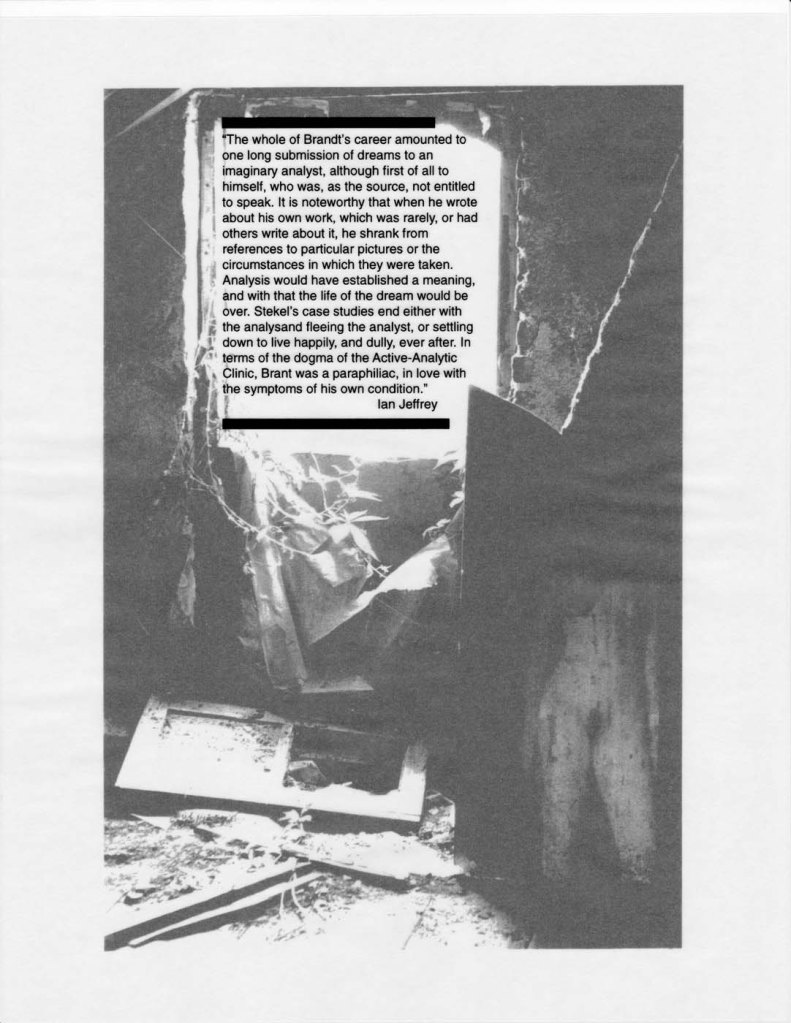
The book consisted of an opening statement and an essay adapted from my MFA thesis titled “The Role of the Unconscious in the Creative Act”. The photographs have an overlaying sheet of vellum that contains a quote related to the unconscious. I hired a graphic designer to create the vellum overlays, the title page and to typeset the printed pages. When I view the book today, I am amazed by the effectiveness of the combination of words and images. Unfortunately, I could not find anyone interested in publishing the book.
I write better than I talk. I am a visual person. When I write, I prefer to use paper and pen. I can see my written work. When I talk, my words are unseen and invisible to my visual brain.
When looking back at my work, has time caused me to see things different? Is my aged vision causing a warping in the way I see? Is my mind reformatting information through different neural pathways? Where did the ideas, the big words, the creative photographs come from? Did I do that? Maybe it is just a trick of my mind.
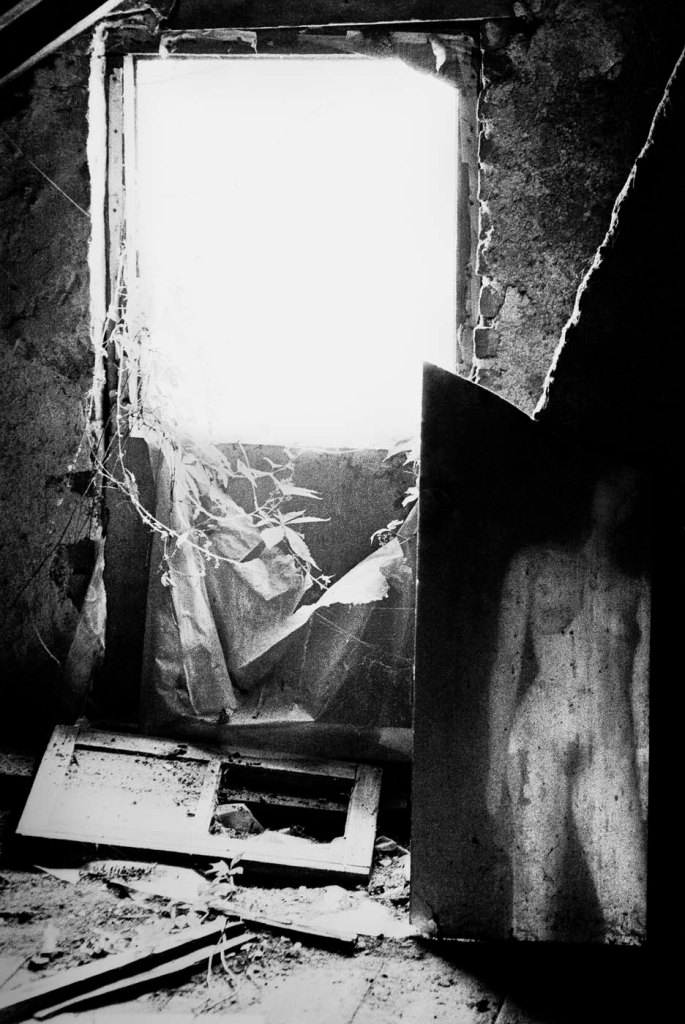
Examples: The first image is the photo with the vellum sheet covering the page. The second image is with the vellum removed. The quote is from the book Bill Brandt Photographs 1928-1983 which was edited by Ian Jeffrey.
Analog photography is still alive and does not want to go away. The latest analog news is the resurgence of old-time photo booths that still use developing chemicals and provide a black-and-white photo strip of four different poses. A company in New York called Classic Photo Booth salvages old booths and restores them. There is also a different company in Europe that refurbishes them.
Apparently, they are a big hit and people are lining up to use them. It is another sign that people are looking for other options besides digital. I am certainly trying to do my best to keep analog alive. I still use 35mm, medium format and 8×10 large format film in my photographic work.
There are now digital “photo booths” that mimic the old-time booths. I attended a wedding where a digital “photo booth” was in operation. Actually, there is no booth involved but just a table, a backdrop, a camera, a printer, some props and an operator. A photo strip of three poses was provided. The digital booth lacked some of the spontaneity of the old-time booth where there was no operator and you enter the booth and close a curtain for some privacy. The photos took minutes to develop, wash, and dry before a strip of images dropped into a slot for pick up.
Photo booths were also used by artists in their creations. Probably the most famous was Andy Warhol and his work with portraits and self-portraits in the 1960’s which he used to produce silk screen prints.
In 2025, the photo booth is 100 years old. Let’s hope analog photography can survive another century.
Photo shot with black and white film using a vintage Olympus Stylus Epic camera. All images are copyrighted.
“he, too, was one of those who pursue life as it flees, a hunter of the unattainable, like the takers of snapshots.”
From the short story “Adventures of a Photographer” by Italo Calvino
I am not sure why photography was so associated with hunting where words such as, photo shoot, snapshot, and capture, are part of the language of photography. Historically (1800’s), the snapshot was a term used in hunting to describe a quick shot. It may have also been the sound that hunting rifles made when fired. Personally, I do not like the word “hunter” which makes me think of killing. I think most photographers are harmless. Why not just use the word photographer. In a previous post “Psychology and Photography” I stated: “I am not a hunter and I do not hunt with my camera but am constantly searching for new avenues for my photography.” The search for the unattainable is a valid characteristic of many photographers. Despite the many failures, the drive to keep looking and photographing seems to be instinctual.
I am a photographer in search of the unattainable. I am always searching for the next great photo. It is my hope that I will get one “exceptional” image during a photo session. Basic elements such as composition, lighting, exposure and focus must be satisfied but more important is whether the image visually excites me. Does it have unique visual qualities such as an interesting juxtaposition, a certain pose or look, a special element that is an unanticipated surprise. The image must make me want to look. Unfortunately, such photos are rare but that doesn’t stop me from my photo searching. The photograph must visually rise above my other images.
It is an innate obsessiveness to find something or someone worthy of photographing. Even when I do not have a camera with me, I still see life in photographic terms. For me, there are unlimited possibilities.
Analog photography is very tactual. I recently was loading large format sheet film into 8 by 10inch film holders which I use in my pinhole camera. It is a very tactile process since it has to be done in total darkness and involves the sense of touch. The film has notches in one of the corners which identify the type of film and also indicates which side is the emulsion side (which has to face out). The dark slide which covers the unexposed film until ready to be used has little bumps along the silver side the top edge which indicates that the film under that side of the slide is unexposed and ready to be used. The other side is black with no notches and this indicates that this film has been exposed. Sounds complicated but the point is that touch is integral to the process.
After I was done loading the film holders, I realized how much I enjoy the tactile sensations experienced in analog photography. The tactile sensations continue through taking the photographs and processing the negatives. Touch is involved in every step.
Whether you are using large format film, medium format or 35mm, touch is essential. Loading exposed film in the dark into a film developing tank in preparation for processing requires touch and dexterity. I use stainless steel developing tanks and reels and I find that the cool smooth touch of the metal is pleasurable.
It is obvious that analog photography has many more opportunities for tactile stimulation than digital photography. I also use digital capture and processing. Sight rather than touch is the most valuable sense in digital photography. Loading and unloading a memory card along with using a computer screen, a mouse and keyboard is basically the tactual highlights. Touching photo paper is the most tactual thing I do in digital.
Over the decades, I feel that my analog work is far better than my best digital work. I recently attended the NiNPAH (Nude in Nature Photo Art Haven) event where I worked with two models for two hours each. I decided to only use black and white film. I exposed two rolls of 36 exposures with each model which is my usual shooting pace. When working in black and white, I visually interpret the scene into a gray scale. I even prefer to watch old television shows and movies that were filmed in glorious black and white. For me, color photography requires a different mindset and is visually less fulfilling than black and white photography.
For me, the tactility of analog photography has no comparison with digital photography. Perhaps that is why there has recently been more interest in analog. People want more of a hands-on approach. I admit that there are many ways to mess up throughout the analog process. I have made what is probably every mistake possible but that is part of the challenge and the results are rewarding.
I can see why most people prefer digital. It is more full-proof (although I have managed to find ways to screw up).
My final argument for analog is that film cameras are less complicated than digital. My Nikon F100 film camera manual has 111 pages. My Fujifilm 645i medium format film camera is 39 pages. My Nikon D750 digital camera manual is 504 pages. In my analog influenced opinion, digital did not make photography easier.
Digital photography is here to stay for now. I only hope that a small space will continue to exist for the few who still use analog photography and value its tactility.
A recent black and white photograph. All images copyrighted.
I continue to discover new words that I had never heard of. It makes me think that I should have put more effort into expanding my vocabulary over the years but then that may have detracted from my visual endeavors. So much of life is a balancing act. A set of scales that measure experiences might help to keep some equanimity and balance. But we usually have priorities and for me it has been to create photographs, although lately I have been reading more which has resulted in my collection of words that were unknown to me.
In addition to stereoblindness (not able to see in 3D), prosopagnosia (face blindness) and erlebniskunst (art of experience), my latest addition is the word ekphrasis which is defined as writing inspired by art. Art can be in the form of a painting, photograph, film, sculpture or even a dance performance. A good example is my previous post regarding my photograph “Repose” and the accompanying description written by a gallery curator. Another example is my post “Olympia by Manet” and my writing about how I reacted to seeing the painting in person.
I always gave my photography students an assignment to select a photograph that interests them and to write about it. They had to provide a description (what they see), an interpretation (what they thought it was about), and an evaluation (whether they liked it or not and why). I was always surprised how insightful they were about the image they selected and the project served as a great teaching tool about art appreciation.
The next time you visit a museum or art gallery and have a strong reaction to a work of art that is emotionally moving you would be experiencing erlebniskunst. And if you go home and write about it that would be ekphrasis.
While doing research for my previous post “Two-Dimension World” I came across a reference to the book The Mind’s Eye by Dr. Oliver Sacks. An entire chapter is devoted to stereoblindness. I also came across another chapter about face-blindness or prosopagnosia which is a cognitive condition.
I did not know that I suffered from face-blindness until I read about it. I have known for most of my life that I had difficulty recognizing faces but I never thought of it as anything abnormal. Because of the inability to recognize faces, I have relied on identifying people by the way they walked, how they talked or some other feature that acts as an identifier. Having this condition can cause awkward moments, especially in social situations when I can’t identify acquaintances but they know me. I usually don’t want to use the person’s name because it may not be who I think it is and I don’t want to use the wrong name.
A recent study by the Harvard Medical School found that one in 33 people may have some degree of face blindness which is more than previously thought.
Is there a connection between face-blindness and photography? In my case, I don’t think it matters when it comes to my personal photography. My condition seems to be limited to living human faces but some people have more severe symptoms where they also cannot recognize people in photos and others may not be able to identify objects.
The artist and photographer Chuck Close had prosopagnosia. He felt it contributed to his unique artistic vision and said “I don’t know who anyone is and have essentially no memory at all for people in real space, but when I flatten them out in a photograph, I can commit that image to memory in a way: I have almost a kind of photographic memory to flat stuff.”
Flo Fox died on March 2, 2025. I had never heard of her but she apparently was a prolific street photographer in New York City. What caught my attention in her obituary was the fact that she was born blind in one eye. She felt it was an advantage as a photographer because she didn’t have to close the blind eye when she took a photo and that she did not see three-dimensionally (3D) which meant she saw the scene as the image would appear as a photo print in two dimensions (2D).
I can relate. I was not born blind but beginning as a teenager I have lost most of my vision in one eye. Besides seeing the world in two dimensions, there is also a loss of depth perception. Like Flo Fox, despite the limitations to my vision, I see the positive side of the handicap. I do see the world as flat and my photographs look exactly as I saw the composition through the camera viewfinder.
It is believed that the artist Rembrandt may have been stereoblind which would have aided him in flattening what he saw for the production of 2D works. Scientists have suggested that more artists seem to have stereoblindness when compared with a sample of people with stereo acuteness (normal stereo vision).
Stereoblindness is defined as the inability to see in 3D using stereopsis, or stereo vision, resulting in an inability to perceive stereoscopic depth by combining and comparing images from the two eyes. Individuals with only one functioning eye have this condition by definition since the visual input from the second eye does not exist.
I have had extremely limited vision in one eye for so long that I cannot remember what a 3D world looks like. I don’t know whether this has made me a better photographer or is it something that I had to adjust to and my photographic output would have been the same.
Erlebniskunst or “experience art” in German, is a philosophical concept that emphasizes the importance of the viewer’s experience in the appreciation of art. It was first developed by the philosopher Hans-Georg Gadamer in the 20th century. Gadamer argued that art is not simply an object to be contemplated, but rather a dynamic process of interaction between the work and the viewer.
From the Philosophy Dictionary of Arguments
Certain words peak my interest. I recently encountered the word Erlebniskunst in an article about art. I related to the concept behind it and wondered if and how it applies to photography.
All the research information that I was able to find came from philosophy articles that stem from the original concept developed by Hans-Georg Gadamer who wrote:
“the power of the work of art suddenly tears the person experiencing it out of the context of his life, yet relates him back to the whole of his existence.”
I noted in a previous post titled “Creators and Observers” that I believed that we need more observers who are sensitive to aesthetic qualities in photographs and that there should be a visual/emotional relationship between the creator and the observer. A photograph that connects with a viewer should be able to create a spell on the observer. Sometimes an image will leave the observer speechless and stir emotions and aesthetic senses.
I feel the “art of experience” can apply to viewers of both photographs and the other arts. The observer must feel the emotional connection which has primacy over what is seen. Unfortunately, many viewers only see what is on the surface of the image. Some pictures will speak to you if you are receptive and allow them to do so.
“Art is only through feeling, so alive and sensitive that the picture is as the breath out of the mouth, but coming from the heart.”—Abraham Walkowitz
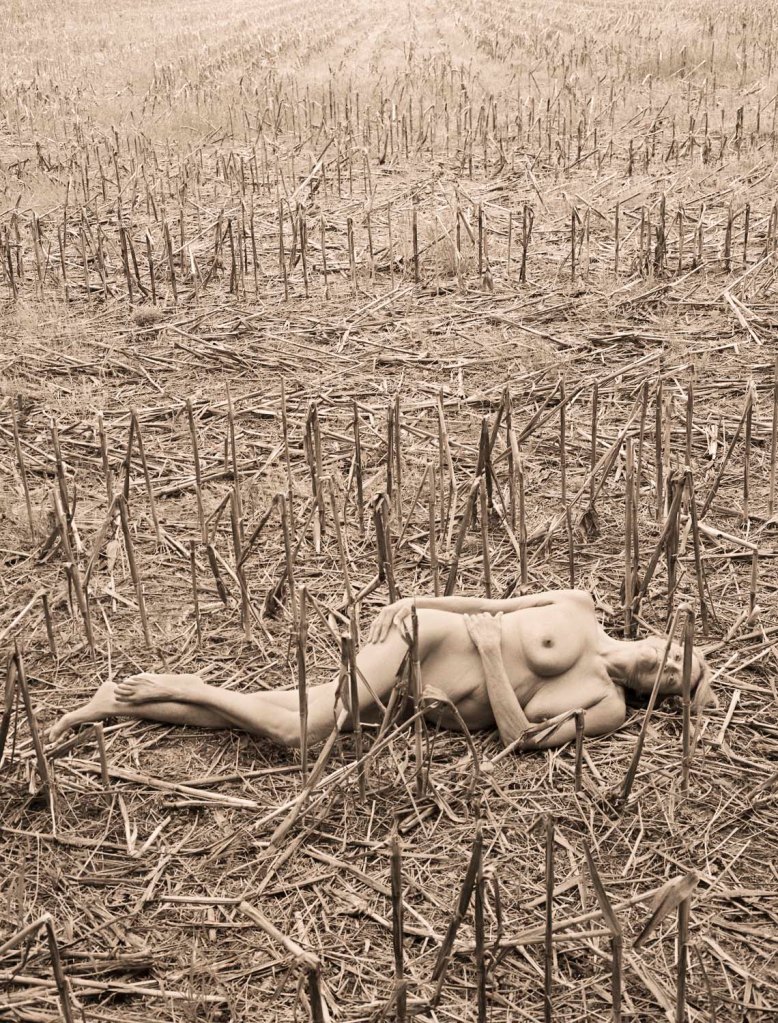
My photograph “Repose” was part of a gallery show. A viewer was having an emotional connection with the work and started telling me what she was feeling. I asked Rachel if she could write down the thoughts that she was experiencing.
“At first glance, “Repose” appears almost apocalyptic – the nude woman, staring blankly off into the distance, her partially curled body laying in a dormant cornfield, the sepia tones of the photograph adding to the eeriness. A quick assumption could be that the figure is dead, a simple conclusion placed together by the drained color palette and lifeless cornstalks. The composition of the picture plane with it’s single point perspective makes the viewer feel as though he/she is physically in the space. The viewer is no longer only an observer, but now also a participant. It’s this play with composition that signals the viewer to take pause, and examine the photograph longer. The figure, and older woman, lays in a pose reminiscent of a relaxed fetal position — a posture associated with new life. However, everything else in this photograph recalls aging, or nearing a state of hibernation, dormancy or death. The field the figure lays in has clearly been harvested, indicating an end to the growing season and an approach toward winter. Winter is often thought of as ‘the end’ of the cycle of seasons: plants fade, animals hibernate, and humans retreat in their own ways, waiting for spring to come when life will re-emerge and be re-born. Winter brings stillness. This stillness is expressed in “Repose.” It’s the stillness that allows the viewer to reflect. While, “Repose” is clearly a photographic commentary on aging, it’s not one of hopelessness. Like the seasons, the figure has lived through seasons of her own life; and in the stillness the viewer recognizes the beauty in her age and the life that she still has left. Moreover, “Repose” causes the viewer to think about his or her own mortality and life. It works as a memento mori of sorts — but a reminder that life continues, rather than a reminder of death.”
I keep coming back to the topic of digital technology and its relationship to photography. I believe technology has had more of a negative impact than a positive one on the quality of fine art photographs made today and going back to the beginning of this century. I refer to this period of time as the “age of digital interruption”. In the photography historical timeline, I believe this period will be viewed as a step backward or at best a period of stagnation.
Part of the problem is technology itself and how it has affected concentration that is needed to create photographs that rise above the mundane. I also blame social media for dumbing down the quality of images. Visual acuity has been dampened by the impersonal “likes” and “thumbs up” given by viewers which then give a false sense of importance to the image maker and the quality of their photographs. The inability to focus attention and the lack of concentration may also be major contributors to the uninspired output of photographs. Today’s digital mind doesn’t want to spend time looking, thinking and interpreting images. It wants a steady stream of information and the ability to make a cursory comment. Volume is more important than quality and personal introspection.
I still make what I think are very creative photographs using digital photography but I sometimes feel that my film and darkroom work was better. The question is why. What is the impact of digital versus film photography? Here are a few thoughts.
With digital you can expose hundreds of frames in a very short time whereas with film photography you were limited by the number of frames on a roll. I believe film required more thought and care because of the cost of each roll and the cost of processing. Visual care was important when working with film. A photographer did not want to waste film. With a digital camera the only limit is the capacity of the memory card. Expose many frames and hope there is one good image.
In film days, I think it was more important to get the exposure correct. There was limited latitude in making corrections in the darkroom to a print. In digital, a photographer can be a little lazy knowing substantial changes can be made during the processing stage.
When using film there was no choice but to pay attention to what was in front of the camera. You could keep your eye on the subject. Concentration was not interrupted. I find that digital photographers like to take a peek at the screen to see what they got. They will even show the subject. This detracts from the actual picture making. That quick peep shifts the photographers’ vision from the subject to the screen and then the attention has to shift back to the subject. I have seen photographers doing this frequently. Continuity is lost.
A digital camera is overly complicated and the processing software is even worse. My current digital camera manual is 500 pages thick. My film camera manual is much simpler.
One of the things that I like about many of my older black and white film images is the play of light areas against dark areas. Sometimes the shadows are devoid of detail and the highlights can be a little washed out. This kind of chiaroscuro is missing from my digital work. It is also missing from most of the digital work of others that I have seen.
Digital is easy to blame but blame can also be placed on photographers and how they use the technology. One of the things that digital has done is to make image exposures almost perfect (even in very dim light) and if not perfect at the time of capture then this can easily be refined during the development phase. There is a sameness and a visual monotony to the photos. The latest digital sensors open up the shadows and tame the highlights. The other aspect of digital where the photographer can be blamed is the use of software that alters the way an image looks. Digital images can be made to look like film or textures can be added to add a painterly touch. Unfortunately, if an image is bland to start with, adding a special effect won’t make it better.
It is up to photographers to keep technology under control. Just because a programmer can write code to make a razzle-dazzle photo feature does not mean a photographer has to use it. Use only the essential digital tools needed to make a finished print. One that shows your personal expression.
Balthus, the artist, was a fascinating character. Nicholas Fox Weber, the writer, wrote an excellent biography on the amazing life of Balthus. The book “Balthus-A Biography” was published in 1999 when Balthus was still alive and Weber was able to interview him over a number of years.
I find that the paintings by Balthus are evocative, provocative, erotic and dreamlike. I felt an immediate connection with his work. Even though his paintings and my photographs are very different, they both elicit similar responses from viewers especially concerning the nudes.
Balthus and I react to probing questions about our work with similar responses. When questioned about the meaning or message of a particular painting, a Balthus response was: “It’s absolutely not symbolic. The meaning of the painting is the painting.”
When Weber asked him about the painting “The Room” Balthus replied that “The Room” is simply a painting of a nude in a room with a girl at the window.
Another Balthus response when questioned about eroticism in his paintings was: “The problem is that everyone sees eroticism. My pictures aren’t erotic. The problem is psychoanalysis.”
Quotes from my writings reflect similar reactions to criticisms of my photographs. In 1997, I wrote a “Personal Statement” as an introduction to a book featuring my early nude work where I wrote: “A common reaction to my work is that the images are disturbing. The images are not disturbing to me. They are simply expressions.”
Another quote which is from my “Artist Statement” is: “I make my work without a social or political agenda. There is no message or hidden purpose. The photograph is the photograph. What the viewer sees and interprets is out of my control.”
While reading the book on Balthus, I found the similarities between our responses and thinking processes to be uncanny. Also, the relentless questioning of Balthus’s artistic intent by Weber reminded me of my graduate school professor, John Weiss, and his agitation with my responses regarding my work. His normal reaction was that I should take more responsibility for my photographs instead of denying intent. Neither Weber or Weiss could accept either of our simplistic responses to our work. They both pushed for more information in an accusatory manner as if we were taking the easy way out instead of searching for meanings in our work. For me the information that was wanted was neither available nor important to me.
An observation made by Claus von Bülow, a friend of Balthus, was that he felt Balthus more as a perpetual voyeur of women that as an active lover. When I photograph a model, I view it as a business relationship and not a chance for a romantic relationship. But I would say that I am a voyeur of women. The difference between Balthus and myself is that he preferred young girls where my preference is to photograph older mature women.
Another difference is that I believe my unconscious plays a role in my image making whereas Balthus vehemently denied any influence from the unconscious.
For me, the work of Balthus stimulated areas of my brain that connected with his paintings even though I cannot verbally say what this connection is. As Balthus said “the painting is the painting.” The visual elements of the painted canvas are all that mattered to him.
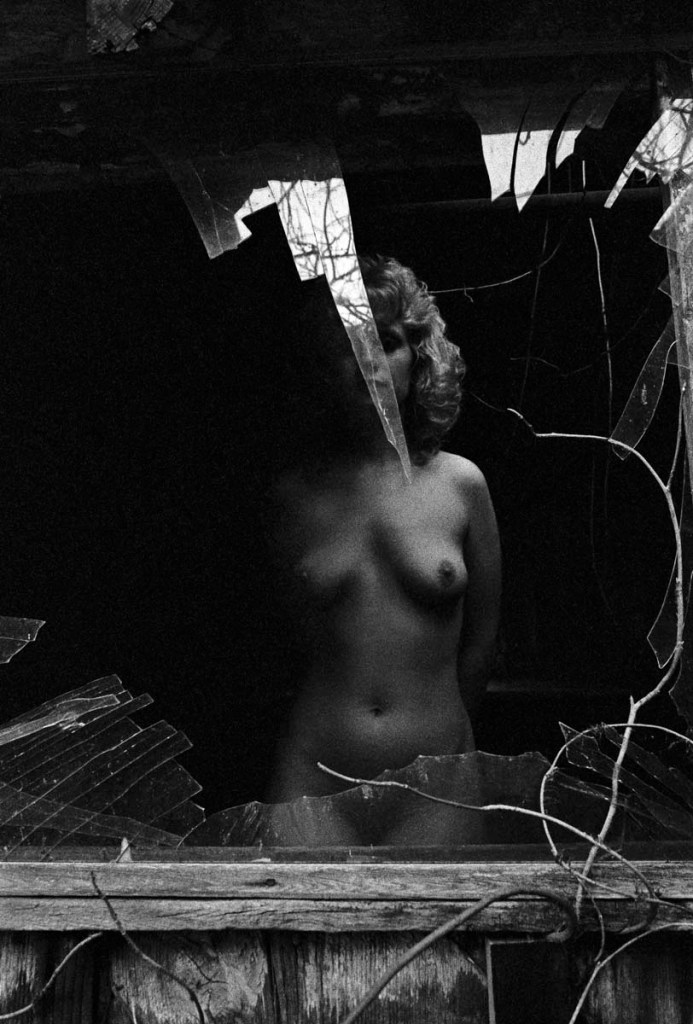
Here is an older photograph from my Collector Series. For me, it is simply a woman standing in back of a window behind a broken shard of glass. The viewer can make more out of it if they wish.

 Sleeping Mind Photography